
Checking Criminal History in San Saba County
No single search returns every San Saba County criminal record. First decide whether the need concerns an agency report, a booking, a filed court case, a statewide history, or current custody. Gather the full legal name, date of birth when known, approximate event date, and any agency case or court cause number. Spelling variants matter. A number is often the best way to separate two people with similar names.
Use the most local source first, then compare it with the next record in the chain. A city or sheriff report describes the event. Booking data records intake. A clerk file shows what was filed and how the court ruled. DPS compiles reportable Texas cycles, but the public product is limited to conviction and deferred-adjudication information authorized for release.
- Call the proper clerk for felony, misdemeanor, or fine-only case records.
- Call the San Saba County lockup for current custody because no public roster is posted.
- Send a precise written request to the agency that created the report.
- Compare the local result with the DPS public name search when statewide conviction data is relevant.
- Use fingerprints for a secure review of your own Texas record, then seek certified local copies when needed.
San Saba County Records Hub
The working center of San Saba County criminal records is the courthouse at 500 E. Wallace Street. The shared County and District Clerk works in Suite 202, the Sheriff occupies the second floor, Adult Probation is in Suite 111, and the countywide justice court is in Suite 110. One address does not mean one jurisdiction. Felony files belong to the District Clerk role; Class A and B misdemeanor files belong to the County Clerk role; fine-only matters go to the justice or municipal clerk.
The Texas Historical Commission courthouse record shows the building that still anchors those record counters.
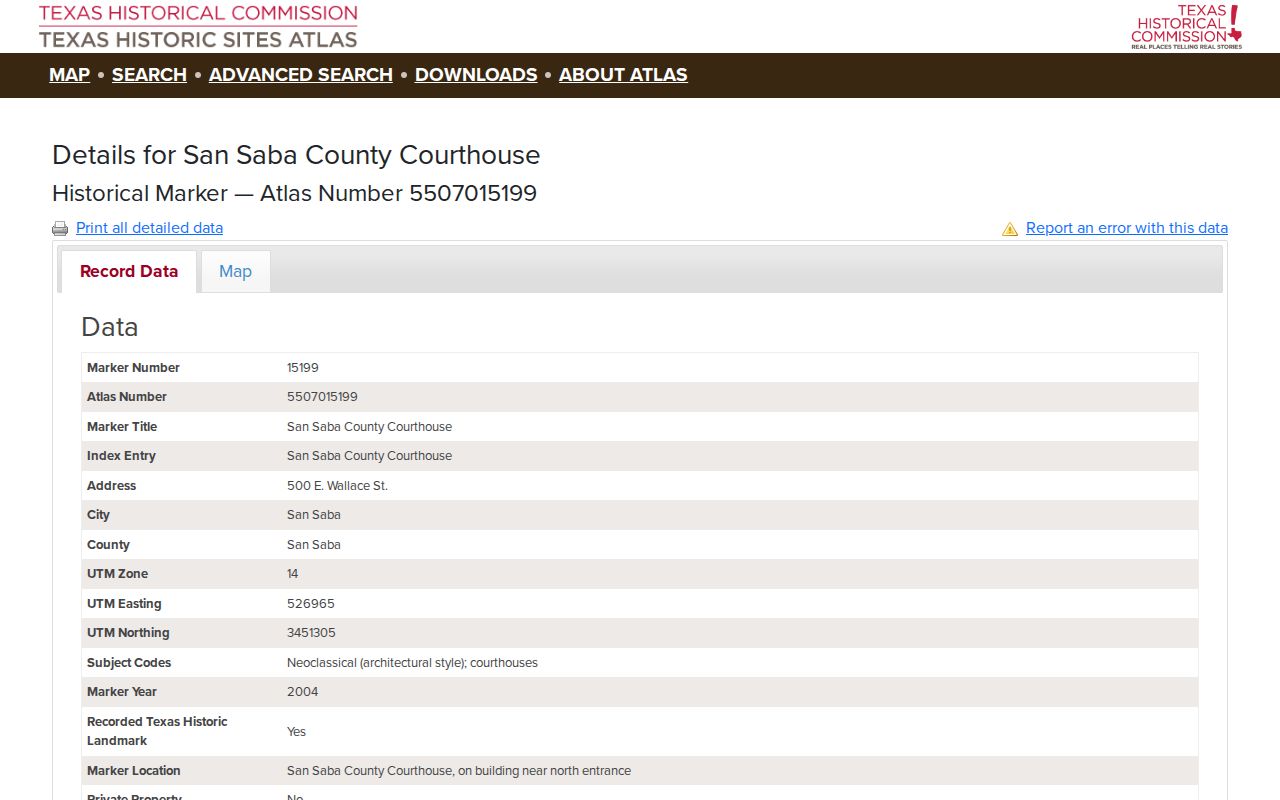
The source reflects a real records campus, not a decorative landmark. The present Classical Revival courthouse was authorized in 1910, completed before the railroad arrived in August 1911, and rededicated after a twelve-year restoration in 2020. Posted hours also differ by office, so callers should confirm the right suite and schedule before travel.
The clerk posts split hours with a lunch closure: Monday through Thursday from 8 a.m. to noon and 1 to 5 p.m., then Friday from 8 a.m. to noon and 1 to 4 p.m. The sheriff's administrative counter posts Monday through Thursday from 8 a.m. to 4 p.m. Official sources do not state modern security screening, recording rules, or a detailed accessible route. Ask the destination office before bringing equipment or planning an accessibility accommodation.
Texas Official Background Checks
The Texas Department of Public Safety Crime Records Division maintains Computerized Criminal History. Its public Criminal History Conviction Name Search discloses Texas convictions and deferred adjudications that state law makes public. It requires an account and prepaid credits. The current online base price is $1 per search credit, and a no-match still uses a credit. Card purchases add the posted surcharge. DPS separately lists a $10 offline name check.
The public search is not positive identification. DPS says fingerprints are the only secure way to establish identity. For review of your own record, DPS Fingerprint Applicant Services of Texas uses IdentoGO. DPS lists a $15 record check plus $10 collection. Search the live appointment system by ZIP because the research did not confirm an enrollment site inside San Saba County.
| Official route | Base fee | Best use |
|---|---|---|
| DPS online name search | $1 credit | Public conviction and deferred-adjudication search |
| DPS offline name check | $10 | Offline name request |
| DPS fingerprint review | $15 | Identity-secure review of your own record |
| FAST collection | $10 | Fingerprint capture for the DPS review |
| FBI Identity History Summary | $18 | Subject-only federal identity history |
The DPS public conviction search provides the state name-check route.
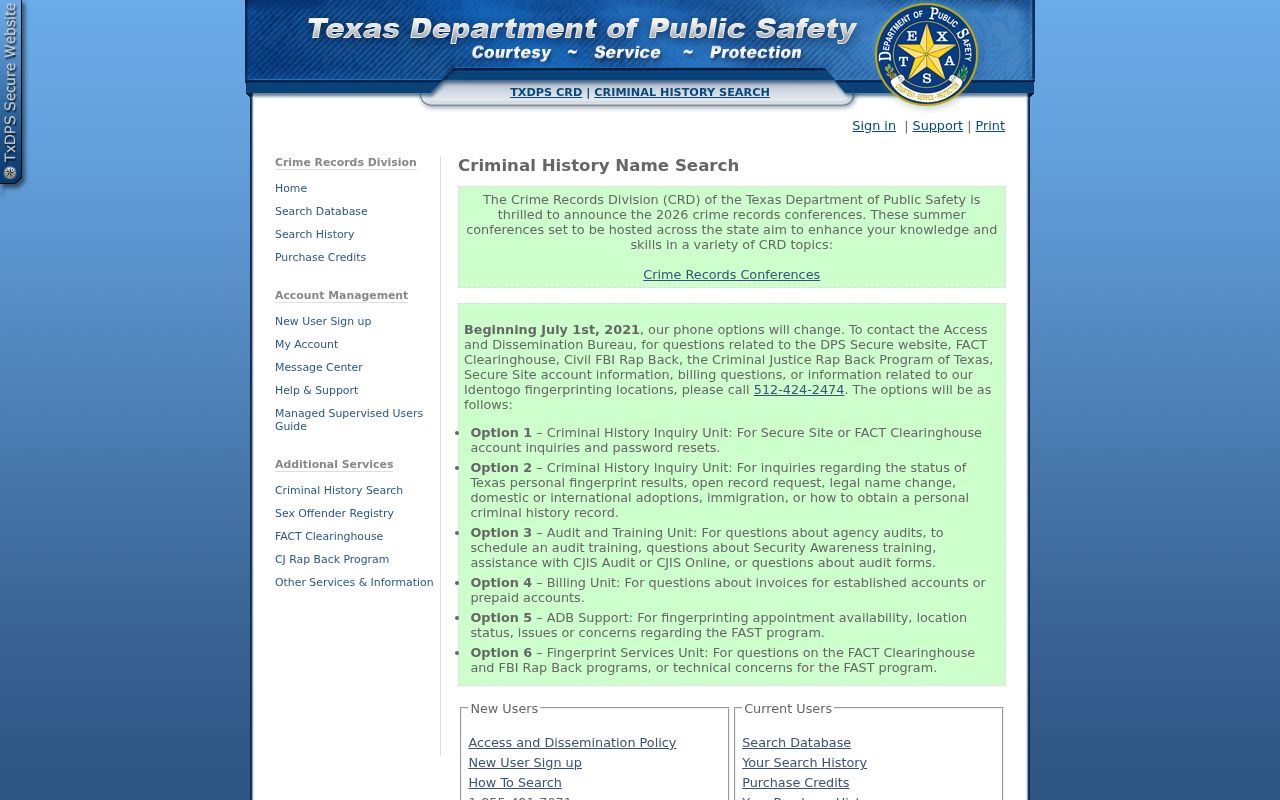
Use exact names and as much correct birth-date detail as possible, then verify any match against local files.
San Saba County Match Limits
A name search and a fingerprint review answer different questions. The DPS form asks for last and first name, permits a middle or maiden name, and accepts complete or partial birth-date elements. It may test Soundex and related combinations. That makes the system useful for finding likely public matches, but it can also return a different person or miss an event that an agency has not yet reported.
The Texas FAST appointment system is the fingerprint entry point for personal review.
Fingerprints tie the request to one identity. They do not replace a clerk file, which remains the best source for pleadings, orders, judgment, sentence, and costs in a San Saba County case.
| DPS field | Required | Use |
|---|---|---|
| Last Name | Yes | Enter the full surname, not a partial name |
| First Name | Yes | Avoid nicknames and initials |
| Middle or Maiden Name | No | Helps narrow similar names |
| Complete Birth Date | No | Month, day, and year |
| Partial Birth Date | No | Available date components |
San Saba County Criminal Record Types
Each custodian builds a record around its own job. That is why a San Saba County arrest report, booking entry, court file, and CCH result may contain different charges or dates without any one file being false. The records capture different points in time.
- Incident and arrest reports: agency accounts of allegations, observations, location, and enforcement action.
- Booking records: intake, fingerprints, charges presented at admission, bond events, and custody location.
- Court files: charging papers, settings, pleas, orders, disposition, judgment, sentence, and costs.
- Warrants: court-issued authority for custody, with no public San Saba County warrant portal.
- Custody and supervision records: county lockup, TDCJ, probation, and parole information held in separate systems.
For court outcomes, use the San Saba County criminal court case process. The clerk's payment and e-filing links are not a public criminal docket search. The official re:SearchTX system also excludes criminal cases.
Two San Saba County Custody Systems
San Saba County has a small local lockup and a large state prison unit, but they are not interchangeable. Historical Commission on Jail Standards data list a twelve-bed county capacity. County financial records reported $293,825 in 2024 inmate-overflow spending, so a current detainee may require a transfer-location follow-up. Call the sheriff at 325-372-5551 because the county posts no roster, booking log, or inmate profile.
The TDCJ inmate information gateway covers sentenced state custody.
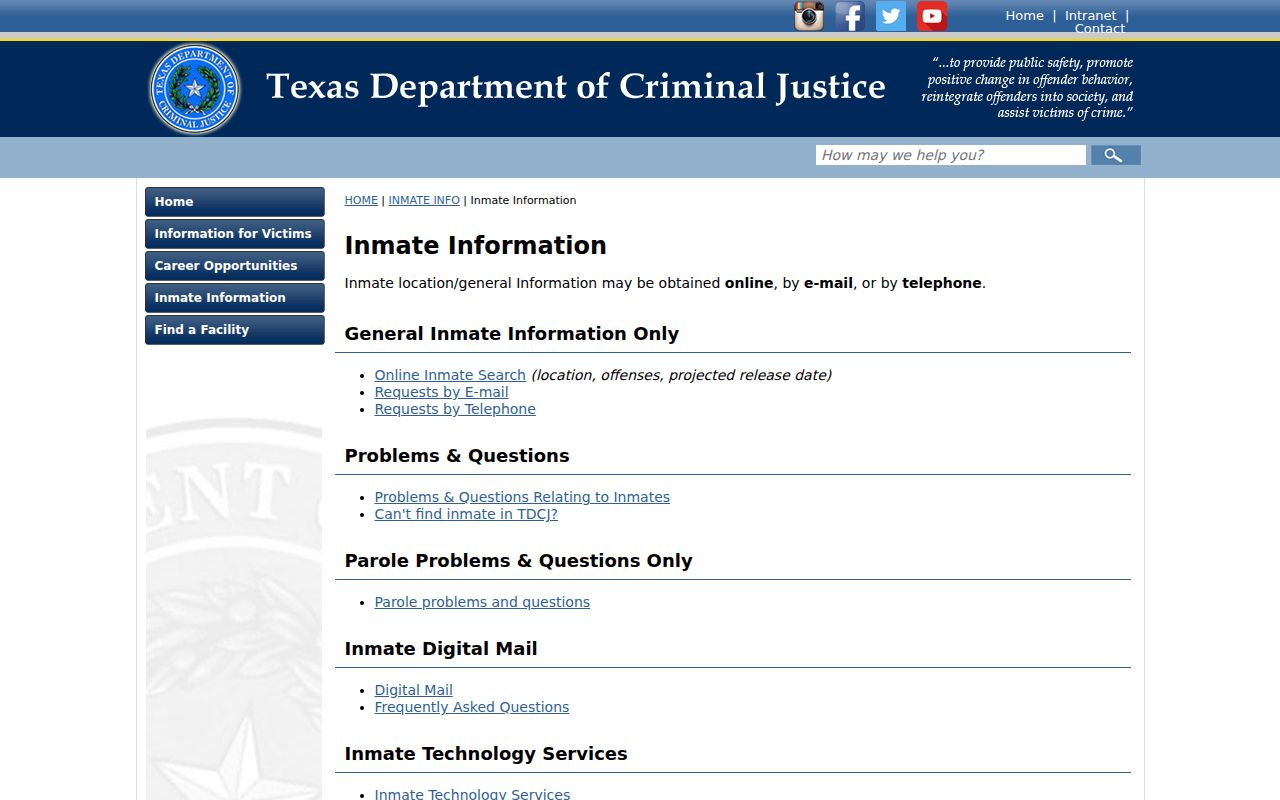
TDCJ search does not confirm a new local booking. It becomes relevant after a person enters sentenced state custody.
The TDCJ San Saba Unit page describes the separate state facility at 206 South Wallace Creek Road.
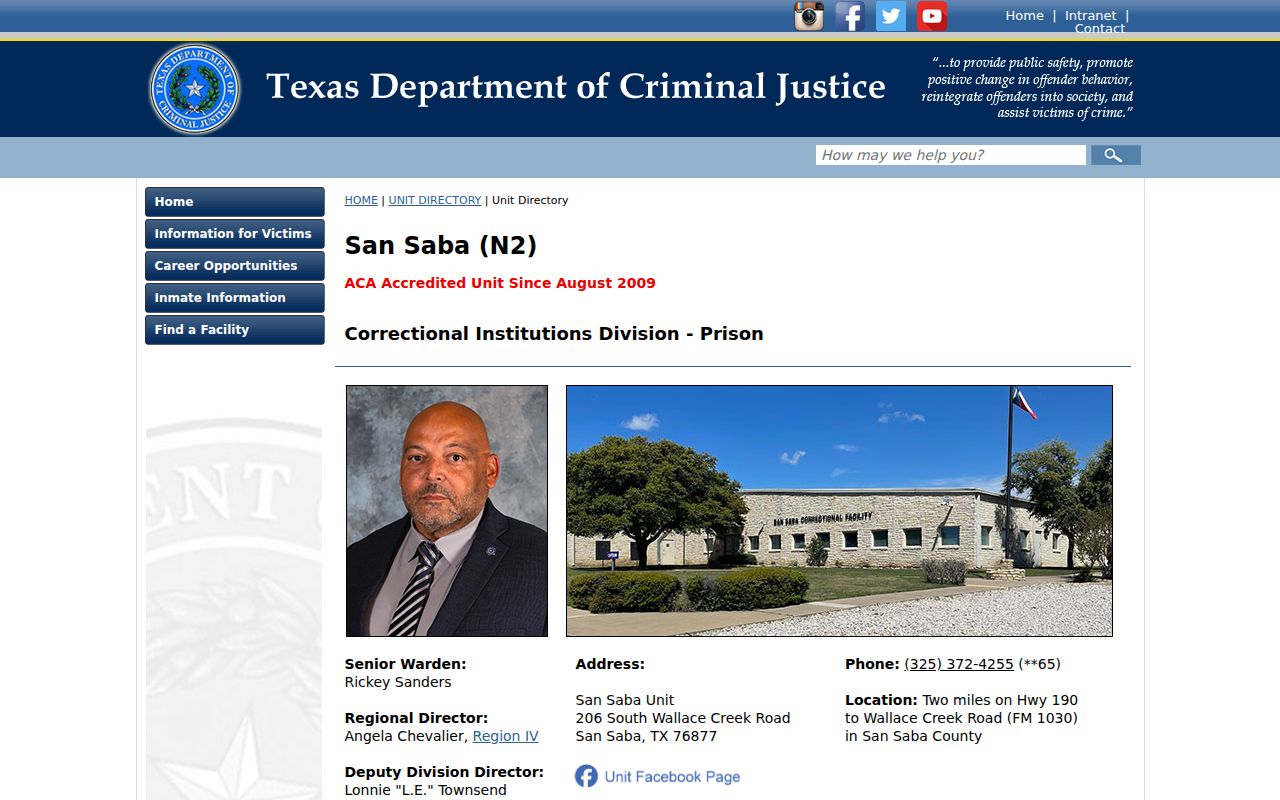
The unit has a listed capacity of 606 and houses sentenced male prisoners. It is not the county jail, sheriff records counter, or court clerk.
Inside a San Saba County Criminal Record
A Texas CCH record is person based. Its identity section may include legal names, aliases, date of birth, a Texas SID, FBI number, and fingerprint identifiers. Each reported cycle can connect an arrest date and charge to prosecutor action, a court cause, disposition, sentence, and later custody or supervision. A missing submission may leave the outcome blank.
| Name and Identifiers | Legal names, aliases, birth date, SID, FBI number, and fingerprint references when recorded. |
|---|---|
| Arrest and Booking | Agency, arrest date, intake charge, booking details, bond, and location when available. |
| Filed Charge | Complaint, information, or indictment tied to a court cause number. |
| Disposition | Dismissal, deferred adjudication, acquittal, conviction, or another recorded outcome. |
| Sentence | Custody, fine, community supervision, and related conditions imposed by the court. |
| Supervision | Probation, revocation events, state custody, or parole reporting when submitted. |
Initial charges can change. Always compare a booking entry with the filed charging instrument and final judgment.
San Saba County Warrant Chain
No official public warrant list, app, or statewide Texas warrant portal was found for San Saba County. Operational systems such as TCIC and NCIC are for law enforcement. A person checking their own status must use a four-office chain: the sheriff for custody and operational direction, the County or District Clerk for filed felony and misdemeanor context, the countywide justice court for JP capias matters, and San Saba Municipal Court for city fine-only matters.
Online silence does not prove there is no warrant. Call the issuing court, ask what type of writ is involved, and obtain current instructions. A bench warrant or capias can follow failure to appear or comply. A capias pro fine concerns enforcement after judgment in a fine-only case. Search warrants may remain sealed during an investigation.
San Saba County Sheriff
500 E. Wallace Street, second floor
325-372-5551
Monday through Thursday, 8 a.m. to 4 p.m.
County and District Clerk
500 E. Wallace Street, Suite 202
325-372-3614
Friday closes at 4 p.m.; lunch closure applies.
Countywide Justice Court
500 E. Wallace Street, Suite 110
325-372-5746
For a safe resolution, verify with the issuing court and coordinate appearance, bond, payment, or counsel as that court directs.
Public Access Laws in Texas
The Texas Public Information Act gives a route to records held by executive agencies, subject to confidentiality and exceptions. Court records are handled through the judicial clerk, not presumed to sit in an executive-agency request portal. DPS criminal history has its own dissemination rules. The sheriff's written form is the most direct route for releasable local reports and booking material.
Key Texas laws:
Government Code Chapter 552 provides the Public Information Act request framework and review deadlines.
Government Code Sections 411.083 and 411.135 restrict CCH while permitting the DPS public conviction product.
Code of Criminal Procedure Chapter 55A governs qualifying expunction proceedings.
Code of Criminal Procedure Chapter 62 controls sex-offender registration and public-field limits.
Public access does not remove redaction rules for juvenile data, victim identity, financial identifiers, or an active investigation.
San Saba County Sheriff Requests
The San Saba County Sheriff's official page supplies the main fallback when no searchable database exists. Send the official Public Information Request form to SSSOrecords@sansabacounty.gov or deliver it to the sheriff counter. The form asks for contact details, a report type, incident date or range, involved names, the case number if known, and a clear description. Booking or warrant material can be described under “Other.”
The sheriff follows the Attorney General's charge schedule. If expected cost exceeds $40, the office provides an itemized estimate and a less costly option when one exists. The requester must answer in writing within ten days or the request is treated as withdrawn. Anticipated charges above $100 may require a deposit or bond. Crash reports follow a separate TxDOT CRIS route, and city police reports stay with the city agency.
The form itself does not promise a turnaround, require notarization, or publish a flat report fee. It offers Theft, Traffic Accident, Fire, and Other choices, plus fields for the incident date, date range, involved people, case number, and a narrative. A narrow description reduces back-and-forth. County pages show two different fax numbers, so email or in-person delivery is the clearer documented route unless staff confirms which fax is current.
Sealed, Expunged, and Restricted Records
Texas uses expunction for qualifying records and orders of nondisclosure for a different form of access restriction. Expunction can direct covered custodians to remove or destroy eligible records. Nondisclosure limits public dissemination while preserving access for agencies authorized by statute. Neither remedy applies just because a charge was dismissed, and successful deferred adjudication does not erase a record on its own.
The local filing path starts with the District Clerk or other proper court in Suite 202. San Saba County publishes no local packet, fixed fee, clinic, or promised timeline. A filer should identify the arresting, booking, prosecuting, court, and repository custodians; obtain arrest and cause identifiers; ask the clerk for the current filing and waiver procedure; then follow Chapter 55A service and hearing rules.
The current Texas expunction chapter is the controlling source for eligibility and procedure.
The law is outcome and timing specific. Verify the resulting clerk file and use a fingerprint DPS self-review if accuracy remains in doubt.
San Saba County Supervision Paths
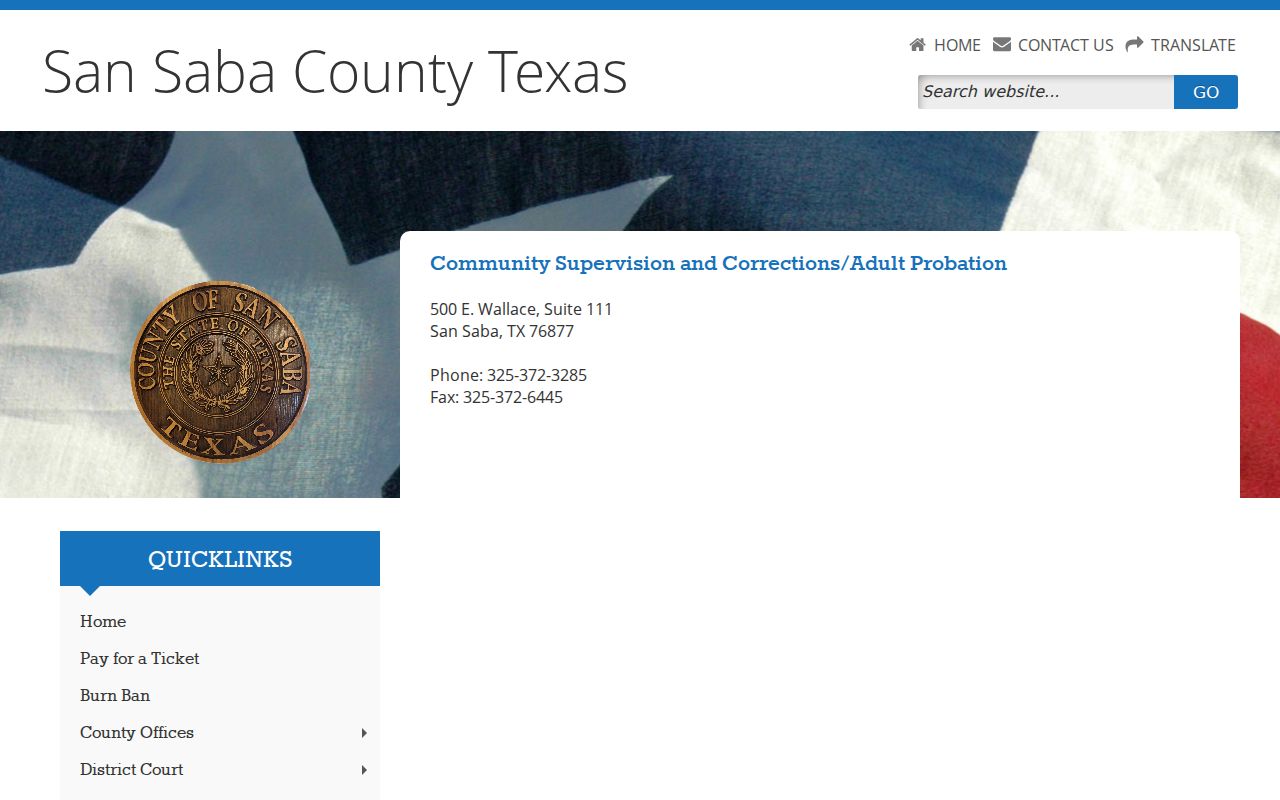
Community supervision and parole are separate. The 33rd and 424th Judicial District CSCD handles local probation-style supervision from Suite 111 at the courthouse, phone 325-372-3285. Its files track assessments, conditions, contacts, testing, referrals, and court coordination. Those supervision files are not a public offender-search portal, though the court case may show the sentence or a motion to revoke.
The San Saba County probation page identifies the local office.
The Texas Board of Pardons and Paroles makes release and revocation decisions, while the TDCJ Parole Division supervises releasees. San Saba County is assigned to the Brownwood District Parole Office. A TDCJ custody search may show parole-related status, but it does not replace the local court judgment.
A technical violation or new allegation may lead to a motion to revoke or adjudicate, a warrant, a hearing, changed conditions, or revocation. The result is case specific. Read the filed motion and court order for the legal outcome, then contact CSCD about your own day-to-day reporting duties.
Federal Records for San Saba County
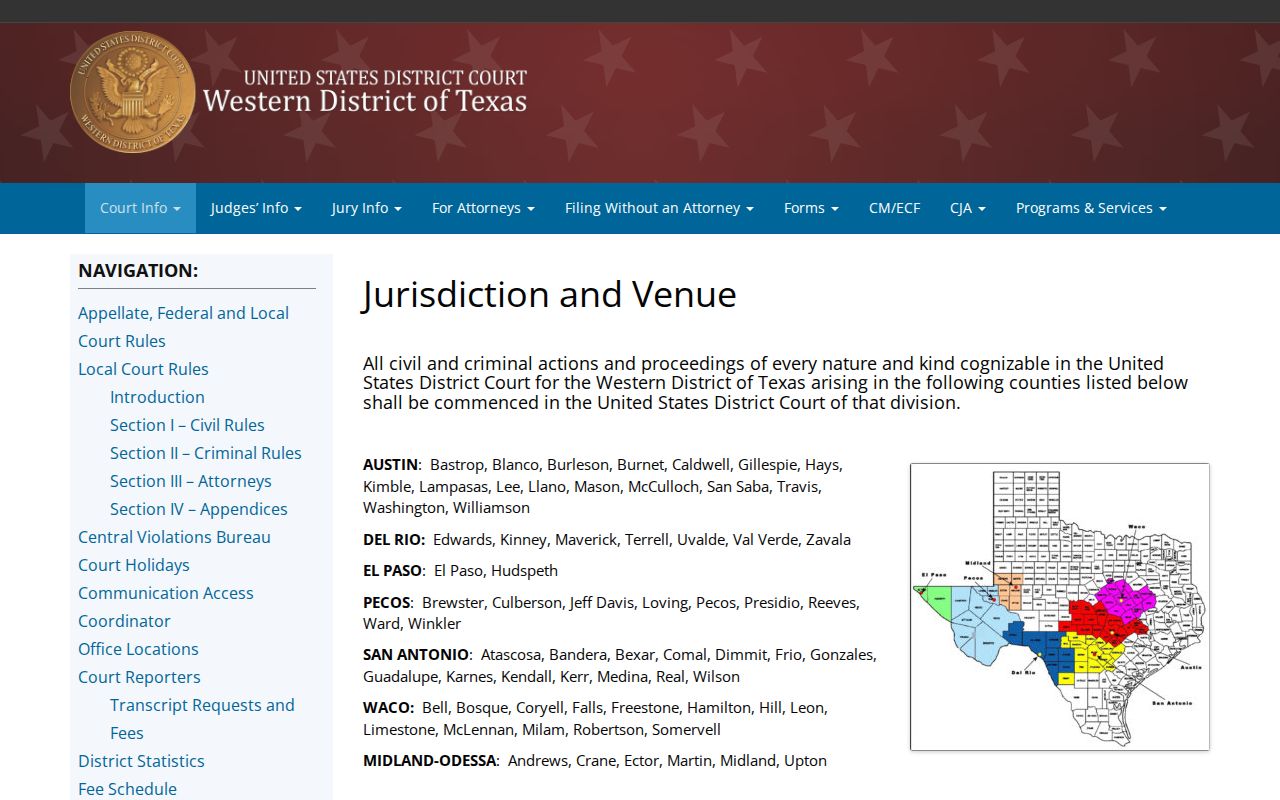
San Saba County lies in the Western District of Texas, Austin Division. PACER is the official federal docket service and charges $0.10 per page under the researched schedule, generally with a $3 cap per document or case-specific report and a quarterly waiver when charges do not exceed $30. Federal cases do not appear in the San Saba County clerk file or Texas DPS public product.
The Western District jurisdiction page confirms the federal venue.
For federal custody, use the Bureau of Prisons rather than the sheriff or TDCJ.
The BOP Inmate Locator supplies that federal custody search.
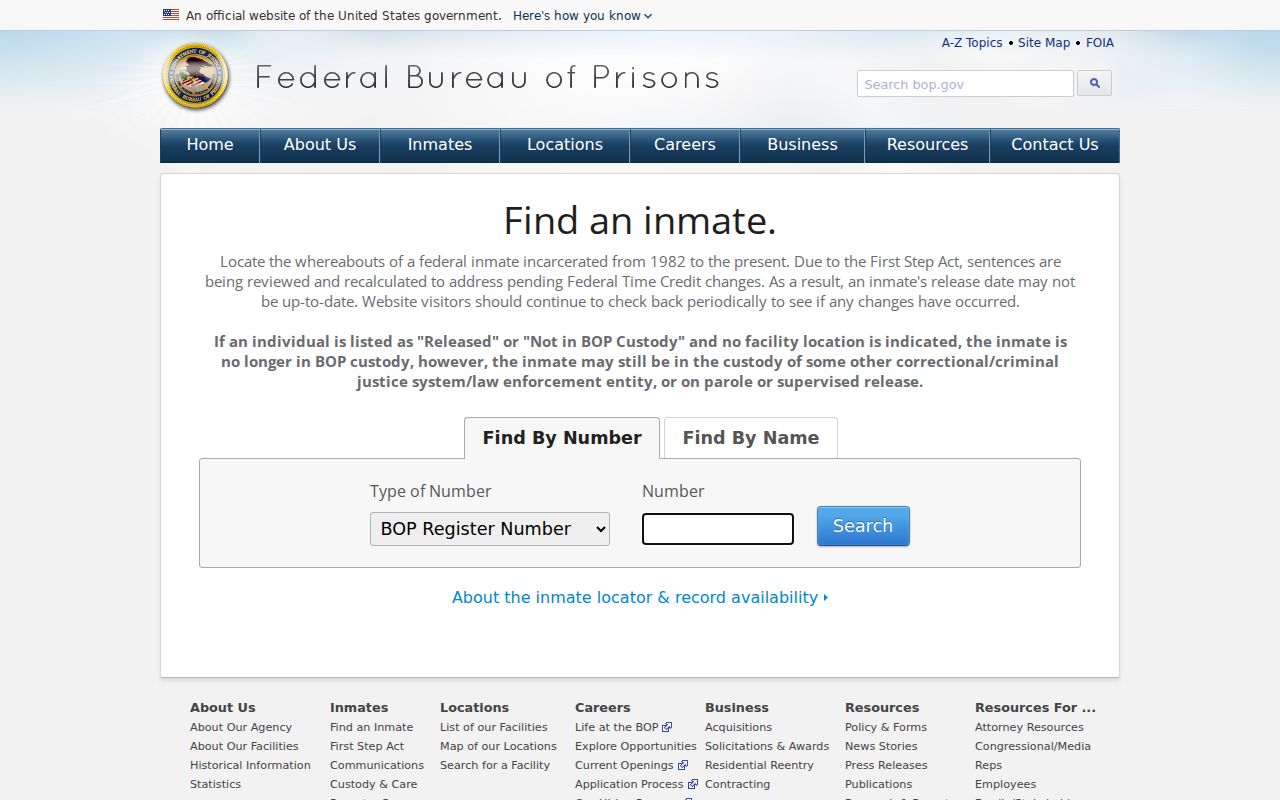
No federal prison was confirmed inside San Saba County. The locator is a nationwide custody layer, not a local booking log.
San Saba County Criminal Records by City
Official 2020 Census and Gazetteer data identify only two incorporated places in San Saba County. San Saba city has its own police department and municipal court, while Richland Springs relies mainly on the county sheriff for law enforcement and maintains a municipal citation portal. Those differences change the first call and the record custodian.
San Saba Criminal Records
3,117 residents in 2020. City police reports and municipal matters begin with city offices.
Richland Springs Criminal Records
244 residents in 2020. Sheriff service and the town's ticket search form the local path.
Cherokee is a recognized community, but the research did not confirm it as an incorporated municipality. It is not padded into the city list.